

Saturday, March 10, 2007

'Jesus tomb' statistics don't add up, biblical scholars say

By Michael Foust
Baptist Press

http://www.bpnews.net/bpnews.asp?ID=25149

NASHVILLE, Tenn. (BP)--An often-quoted statistic behind the so-called “Jesus tomb” is inflated and based on false assumptions, leading biblical scholars say. “The Lost Tomb of Jesus” documentary aired on the Discovery Channel March 4, claiming a tomb in Jerusalem once housed the bones of Jesus and his family and that the odds of it not being Christ's tomb are only 1 in 600. That statistic has formed the core of the argument for the program's backers, who say the likelihood of finding another tomb with ossuaries containing the inscriptions “Jesus son of Joseph,” “Mary,” “Mariamene e Mara” and “Jose” is slim. The documentary said “Mary” was Jesus' mother, “Mariamene” his wife Mary Magdalene, and Jose his brother. Two other ossuaries found in the tomb -- those of a Matthew and a “Judah son of Jesus” -- also were members of Jesus' family, with Matthew being of an unknown relation and Judah being the son of Christ and Mary Magdalene, the documentary claimed. (The statistic, though, did not include Matthew or Judah in the formula.)The overwhelming majority of archaeologists and scholars have refuted the claims, and the statistician behind the numbers -- Andrey Feuerverger of the University of Toronto -- posted a statement on the school's website saying his statistic “depend[s] heavily on the assumptions that go into it.” Among those assumptions, Feuerverger said, are that “Jose” is the brother of Christ referenced in Mark 6:3 and is not the “Joseph” referenced on the Jesus ossuary. (Jose is a nickname for Joseph.) But most significantly, Feuerverger said, the statistic assume that “Mariamene” is Mary Magdalene, even though she is not given such a name in the New Testament, and even though the New Testament says nothing about Christ being married and implies strongly He wasn't. Putting Mariamene in the formula “drives the outcome of the computations substantially,” Feuerverger said. “It is not in the purview of statistics to conclude whether or not this tombsite is that of the New Testament family,” said Feuerverger, who stands by his formula and says it will be published for peers to review. “Any such conclusion much more rightfully belongs to the purview of biblical historical scholars who are in a much better position to assess the assumptions entering into the computations.”In fact, one religious scholar, Louisiana College's Charles Quarles, put together his own statistics -- excluding Mariamene since he believes the evidence is overwhelmingly against her being Mary Magdalene -- and came up with something very different from Feuerverger. Quarles says between 56 and 105 males in Jerusalem during Jesus' time would have had a father named Joseph and close relatives named Mary and Jose. Thus, according to Quarles, it is very unlikely the tomb belongs to Christ -- even if one discounts the bodily resurrection.Both sides of the debate acknowledge the names on the ossuaries were common for the time. Roughly one-fourth to one-fifth of all women were named “Mary.” “Joseph” was the second most common male name, “Jesus” the sixth. Feuerverger's formula included a 1 in 4 chance that a woman at the time would be named Mary, and a 1 in 20 chance that a man would be named Jose. He put the odds at a Jesus being the son of a Joseph at 1 in 190, and the odds of a “Mariamene e Mara” being found at 1 in 160. Putting all the numbers together in a formula, Feuerverger came up with the 1 in 600 stat. (Such odds about first-century names are based on a database of approximately 3,000 known people at the time.) The name “Jesus son of Joseph” on an ossuary is rare, but not a first; at least one other one has been found elsewhere. But it is the odds Feuerverger placed on the Mariamene ossuary that have many scholars scratching their heads.The documentary interpreted the “Mariamene e Mara” ossuary, which is in Greek, as reading, “Mary, known as Master.” That specific translation changed the odds from a relatively unimpressive number to the aforementioned long odds of 1 in 160, since those associated with the documentary said it was a rare find. But Richard Bauckham, professor of New Testament at the University of St. Andrews in Scotland, disagrees with the translation. “'Mara' in this context does not mean Master,” Bauckham wrote in a statement posted on several scholarly weblogs. “It is an abbreviated form of Martha. Probably the ossuary contained two women called Mary and Martha (Mariamne and Mara).”Craig Blomberg, professor of New Testament at Denver Seminary, also disagrees with the documentary's translation and believes the inscription likely is one person named “Mary Martha.” Either Bauckham's or Blomberg's interpretation would change the statistical formula dramatically and lower the odds, since Martha was the fourth most popular female name at the time, and Mara the eighth. Dozens of such common names on ossuaries have been found.The documentary tied the “Mariamene” with Mary Magdalene by using a non-biblical document, the Acts of Philip, which was written several hundred years after Christ and which references a “Mariamene.” But Quarles says the document never identifies Mariamene as Mary Magdalene but simply calls her the sister of Philip. More importantly, Quarles said, the New Testament never calls Mary Magdalene “Mariamene.”Scholars say there are other problems with the documentary's claim that would have impacted the statistical formula: -- Jose's ossuary does not list him as a son of Joseph, while the Jesus ossuary does. The documentary claimed Jose and Jesus were brothers and sons of Joseph. If Jose is taken out of the formula, it would lower Feuerverger's odds. “[T]he lack of the 'son of Joseph' description significantly decreases the probability that Yeshua and Jose were siblings,” Quarles wrote in an analysis.Additionally, the other brothers and sisters of Jesus listed in Mark 6:3 are missing from the tomb. That verse lists four brothers -- James, Joses, Judas (not the traitor) and Simon -- as well as an untold number of unnamed sisters. -- Jose (short for Joseph) may have been the father of the Jesus in the tomb, Quarles said, and not the brother. If true, then Jose was listed twice in the formula, incorrectly raising the odds.-- Judah and Matthew are not listed as Jesus' family members in the New Testament. Some scholars say that fact alone should invalidate the documentary's claim, much less the statistical formula. There is no historical evidence for Christ having a son.-- Jesus was not known as the son of Joseph by his family or disciples. Writing on his blog, Ben Witherington III, professor of New Testament at Asbury Theological Seminary in Wilmore, Ky., quotes Luke 3:21, which says Jesus was only the “supposed” son of Joseph.“Supposed by whom? Clearly not by Luke or the family whom Luke has just shown knew about the virginal conception of Jesus,” Witherington wrote. “Even the cousins knew about this miracle when Mary told Elizabeth. There can be no good reason Luke would put it this way if he knew the earliest followers of Jesus or members of his family had thought that Jesus was son of Joseph.”-- The Jesus ossuary does not say Jesus but possibly “Hanun,” according to Stephen Pfann, a biblical scholar at the University of the Holy Land as quoted in the Associated Press. That, obviously, would end the debate for good.Christians, Quarles said, should not discount the claims of the documentary but instead should “appeal to the compelling eyewitness accounts of the resurrection” in the New Testament -- which he notes are the oldest and most reliable accounts -- and then “carefully scrutinize the exaggerated, illogical, and poorly substantiated claims” of the documentary and its accompanying book, “The Jesus Family Tomb.”“The sensational claims of The Jesus Family Tomb will be major news for some time and this book and film, like the Da Vinci Code, will provide informed believers with an excellent opportunity to present the compelling evidence for Jesus’ bodily resurrection, an essential element of our Christian faith (Romans 10:9),” Quarles wrote. “But let’s 'make no bones about it,' the bones in the Talpiot tomb were not the bones of Jesus of Nazareth.”--30--Quarles complete paper is available online at:http://www.lacollege.edu/ifl/jesus_tomb.pdf


Friday, March 9, 2007

Odds of 'Lost Tomb' Being Jesus' Family Rest on Assumptions

By CARL BIALIK
THE NUMBERS GUY

http://online.wsj.com/public/article/SB117338464249431351-0ghR_0Jef5ubo6ZLbYIVoePRxrA_20070408.html?mod=tff_main_tff_top

Until two weeks ago, University of Toronto statistician Andrey Feuerverger's body of research encompassed uncontroversial topics such as medical scanning and correcting for camera blurring.
So he was unprepared for the reaction to his work for the Discovery Channel documentary "The Lost Tomb of Jesus," which aired on Sunday. The tomb is a set of 10 limestone coffins, or ossuaries, found in Jerusalem in 1980, bearing the names Yeshua bar Yosef (Jesus, son of Joseph), Maria (Mary), Matia (Matthew), Yose (a nickname for Joseph), Mariamene e Mara (a form of Mary) and Yehuda bar Yeshua (Judah, son of Jesus). Prof. Feuerverger calculated there is just a one-in-600 chance that those same names would have come together in a family that didn't belong to Jesus of Nazareth.
That calculation helped propel the already explosive story. "It was really the thing that began to convince us all to give this more attention," says James Tabor, chair of religious studies at the University of North Carolina, Charlotte, who advised the filmmakers and Prof. Feuerverger, and appears in the two-hour documentary.
But the one-in-600 calculation is based on many assumptions about the prevalence of the names and their biblical significance. For purposes of his calculations, Prof. Feuerverger relied on new scholarly research that links the inscription "Mariamene e Mara" with a name for Mary Magdalene. (The filmmakers suggest that she was Christ's wife and that they are buried with a son, Judah -- claims hotly denounced by traditional Christians.)
Had the professor assumed the inscription could be for any Mary, a very common name then, it would be far less likely that Christ's family is in the tomb. The mathematical finding would become "statistically not significant," Prof. Feuerverger tells me. Similarly, the name "Yose" -- as one of Jesus' four brothers was called in the Gospel of Mark -- is a derivative of Yosef, another common name. There, too, the finding would be less conclusive if the professor had considered "Yose" applicable to any Yosef.
Even if there was consensus on the interpretation of the names, there are no comprehensive records showing how frequently they occurred in the population at that time. Prof. Feuerverger relied on modern books about ossuaries and ancient texts to tally the occurrence of certain names in the area then. That falls far short of a complete census.
"As you pile on more assumptions, you're building a house of cards," says Keith Devlin, a Stanford mathematician and NPR's "Math Guy." (Scientific American also challenged the calculation on its Web site.)
No one is questioning Prof. Feuerverger's statistical credentials, or his calculation given the assumptions made. For each of the names believed to be appropriate for Jesus or an associate, Prof. Feuerverger calculated the probability it would arise by chance, then adjusted for other factors, such as the number of tombs in Jerusalem. But his conclusion is only as reliable as the assumptions that went into it.
"I wouldn't be comfortable coming up with a number like this, because the general audience will not understand that it is very, very subjective," says Ivo Dinov, assistant professor of statistics at the University of California, Los Angeles.
The case is far from closed on this tomb. Prof. Feuerverger, who says he was paid a "nominal" sum for his work, had signed a nondisclosure agreement with Associated Producers, barring him from describing the project and so limiting his ability to run his work by his peers. He still hasn't provided full documentation of his calculation, saying he'd wait until his paper, not yet completed, is accepted by a journal. "There is a mismatch between how the media works and how academia works," Prof. Feuerverger says. "Obviously it would have been a whole lot better if I had completed the paper" before the documentary aired.
Writer-director Simcha Jacobovici says he went to great lengths to find a responsible number. Initial, "ballpark" calculations based on the incidence of the names -- including one made by Charles Pellegrino, co-author of the documentary's companion book -- found even smaller probabilities that the tomb wasn't that of Jesus' family. Mr. Jacobovici then turned to the University of Toronto, down the street from his production offices, and tapped Prof. Feuerverger to do the calculations with greater rigor. "We told him Charlie came out with 2.4 million to 1," Mr. Jacobovici says. "He said, the numbers will come out where the numbers come out."
All this has brought some measure of distress to Prof. Feuerverger, who nevertheless says he thinks the experience will strengthen him as a human being, and as a statistician. "When I was doing the calculation, I was naively unaware of the extent to which the filmmakers might be depending on the ultimate result of it," he says. "I did carry out the calculation in every good faith. I hoped it would be interpreted in that light."

Jerusalem bishop: Film on Jesus tomb 'should just be ignored'

By Dennis O'Connor

http://www.the-tidings.com/2007/030907/tomb.htm

Auxiliary Bishop Giacinto-Boulous Marcuzzo of Jerusalem called James Cameron's Discovery Channel documentary, "The Lost Tomb of Jesus," nothing more than "a question of business."
Bishop Marcuzzo said that the film, which aired March 4 in the United States and March 6 in Canada, was just an attempt by the Oscar-winning director of Hollywood films "Titanic" and "The Terminator," to make a profit.
In a March 1 interview in Nazareth, the bishop said the documentary has the potential for creating confusion among the faithful by purporting that a tomb discovered nearly 30 years ago in Jerusalem's East Tlpiyot neighborhood contained the bones of Jesus, Mary Magdalene and their "son," Judah.
"People of faith, everyone, really, should dismiss this as nothing but nonsense," he said. "It should just be ignored."
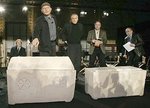
At a press conference in New York City Feb. 26, Cameron, who is Canadian, and his partner, Israeli-born filmmaker Simcha Jacobovici of Toronto, announced that by using new technology and DNA studies they determined that among 10 ossuaries -- burial boxes used in biblical times to house the bones of the dead -- found in the cave by Israeli archaeologist Amos Kloner in 1980 are those of Jesus, his brothers, Mary, another Mary whom they believe is Mary Magdalene, and "Judah, son of Jesus."
Kloner wrote the original excavation report on the site for what is now called the Israel Antiquities Authority. He has called the fimmakers' claim "nonsense."
Bishop Marcuzzo told a visiting U.S. Catholic journalist that the filmmakers have not only distorted the facts to make their case, they have ignored hundreds of years of scholarship and the plethora of archaeological materials that continue to emerge in the Holy Land.
"We are accustomed to finding" artifacts such as these throughout Israel, he said. "This is occurring all the time here. And (the filmmakers) have ignored what Jewish scholars say about the names contained" on the ossuaries, "that they were names very common during that period."
Most important, he said, Cameron, Jacobovici and their consultants failed to account for the archaeological value of oral tradition in determining historical site locations, such as the tomb of Jesus that has always been recognized by the church.
Situated in Jerusalem's Old City at the Church of the Holy Sepulcher, an ancient church was built at the tomb initially in the fourth century by the Roman emperor Constantine after his mother, Helen, identified its location based on local traditions maintained by Christians since the time of Christ's death and resurrection.
"We know where the sepulcher of Jesus is located in Jerusalem," Bishop Marcuzzo said. "This is based on long traditions from both Christian and Jewish sources. I would tell people of faith that they should treat this (film) as nothing but a way to make money."
In the United States, the husband-and-wife team that runs the Turin Shroud Center in Colorado Springs, Colo., said in an interview after watching the program that they saw many inconsistencies that make them skeptical.
"The most reasonable explanation is that they're dealing with some other tomb that has no connection with Christianity," said John Jackson, who with wife Rebecca runs the center, which is dedicated to studying and educating the public on what many believe is the burial cloth of Jesus.
The film "did not have any substance to it, but it is not going to go away very easily," John Jackson, a Catholic, told The Colorado Catholic Herald, newspaper of the Colorado Springs Diocese. "I think the church is going to have to weather the storm."
If the theory put forth by the Discovery Channel program were to prove true, it would be contrary to all the Jacksons have gathered about the cloth.
"I think the Shroud of Turin and this archaeological site cannot both be correct," said John Jackson, a physicist who started studying the shroud in 1974. "The shroud points to resurrection. This site does not. It nullifies the Resurrection and therefore nullifies all of Christianity."
Rebecca Jackson, a convert to Catholicism from Orthodox Judaism and an expert on ethnology and early Judaism, noted inconsistencies with how the ossuaries were named and also doubts the inscriptions would have been made so hastily and sloppily on the side of boxes.
Jewish tradition called for people to be buried in a shroud for one year before having their remains transferred to an ossuary.
"They had a year to work on it. It would have been neat," she said, also noting that floral patterns on the ossuaries are Hellenic and not in line with Jewish custom. "They would have been as traditional and Semitic as possible."

Thursday, March 8, 2007

Jesus' tomb buried in controversy

The Discovery Channel aired a documentary that some say is just an attempt to make money
By: Tess McBride News reporter

http://media.www.dailyemerald.com/media/storage/paper859/news/2007/03/08/News/Jesus.Tomb.Buried.In.Controversy-2764618.shtml

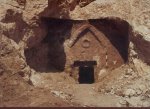
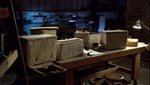
Throughout the millennia, the subjects of Jesus and Christianity have become as much historical as religious. "The Lost Tomb of Jesus," a documentary which aired Sunday on the Discovery Channel, claimed Jesus' family tomb was discovered, fueling both possibility and controversy as viewers examined the science behind Christianity.Produced by James Cameron, the director of "Titanic," the two-hour documentary began gaining publicity early last week when questions started arising over the accuracy of Cameron's claims that this is Jesus of Nazareth's tomb, and whether he was married and had a son.Since the airing of the show, scholars, religious leaders and students have commented on what they saw, if they believe it's accurate and what effect they think it will have on Christianity.What the documentary saysThe documentary begins by explaining the basics of what was found before venturing into what it could possibly mean.In 1980 in Talpiot, the suburbs of Jerusalem, Israeli construction workers discovered the 2,000-year-old tomb while digging the foundations for an apartment building.On the outside of the tomb, above the entrance, there was a decorative symbol, a chevron - an upside-down V - and a circle below it. Found on the inside were ten ossuaries, which are limestone boxes used to store the bones of the dead. "Five of the 10 discovered boxes in the Talpiot tomb were inscribed with names believed to be associated with key figures in the New Testament: Jesus, Mary, Matthew, Joseph and Mary Magdalene. A sixth inscription, written in Aramaic, translates to "Judah Son of Jesus," according to a Discovery Channel news article.Because of the extreme commonality of these names, the ossuaries were recorded and written about in scholarly journals, but the idea that these were the remains of Jesus and his family, including his wife, Mary Magdalene (also known as Mariamne) and their son, Judah, were not widely considered.The documentary states according to a statistical study, "the probability factor is 600 to 1 in favor of this tomb being the tomb of Jesus of Nazareth and his family" according to the grouping of the names (including "father" or "son" on the inscriptions). The film also documents mitochondrial DNA testing of the mother line, gathered from human residue found in the ossuaries of Jesus and Mary Magdalene. The tests proved the two were not maternally related."That means a couple of things. They were not siblings. They were not mother and child or father and daughter. They were unrelated. People buried in tombs are related in one of two ways: either by blood or by marriage. The results revealed an explosive possibility: that these two individuals, Jesus, son of Joseph, and Mariamne, were likely related by marriage," the Discovery Channel Web site stated.What a student saysUniversity student Bassel Menzalji said even though he's Muslim and doesn't follow Christian beliefs, he watched the documentary because the subject is sparking controversy."I believe in Jesus, but I also believe in Mohammed and I also believe in Buddha," Menzalji said, who added that he didn't know if he thinks the documentary was accurate or if it was made for the money and headlines. He said, "It doesn't matter is it's fake or real," because it caught peoples' attention.Either way, Menzalji found the documentary interesting and doesn't think the controversy will affect Christianity and the religion's followers."You can't just take away something that touches so many people's lives," he said. "Science and religion don't really mix."What a professor saysUniversity religious studies professor Daniel Falk said the documentary was based on unsound facts and was irresponsibly made. He said it exploited archeology and was created for economic, rather than scientific, gain."This is part of a broader problem in archeology today, partly in the Bible, where stuff gets exploited for making money," he said. "The fundamental arguments behind the documentary have yet to be proven."Falk, who specializes in early Judaism and Biblical studies, said the knowledge of this tomb and the names on the ossuaries have been known and studied by experts, the majority of whom are not convinced this was the tomb of the Biblical Jesus due to the commonalty of the names."These were known by experts in the field and then you (have) someone knowing nothing about archeology making these huge claims," he said.Falk added that a significant error in the documentary was the assumption that the ossuary of James, Jesus' brother, came from the same tomb, which the show said turned up on the black market in 2002 and is inscribed, "James, son of Joseph, brother of Jesus.""It remains doubtful the James ossuary came from the same tomb," Falk said.The documentary said experts could test the mineral particles gathered from James' ossuary and compare them with particles from the other ossuaries in the tomb, also including random ossuary samples in the study, to prove James' ossuary came from the same tomb.Falk said this would not conclude the ossuaries are from the same tomb because many of those buried in Jerusalem came from the same area of land, which he has visited, and it would be likely they had the same mineral deposits.What a pastor saysDr. Britt Minshall, a pastor and theologian of the United Church of Christ in Baltimore, has appeared as a religious consultant on FOX News Channel, CNN, and ABC.Minshall said that he, too, believes the Discovery Channel's motives are financial in airing the documentary, which, in his opinion, is not authoritative in any way.The engraved chevron and circle symbol over the entrance to the tomb is not consistent with that of the time of Jesus, said Minshall, who "has served as a religious consultant for archaeological expeditions in Africa, Central America, and the Middle East," according to his bio.Minshall said he believes the tomb was set up, not by the show's producers, but by worshipers and/or entrepreneurs around the eighth or ninth century."It's possible some rich guy who lived in Jerusalem at the time wanted to make a shrine," he said.Another possibility he said was that the tomb was "like a circus side show," created for the crusaders who would often purchase bones of alleged Biblical mentions to show their friends and families at home. The tomb could have been a form of entertainment for them, Minshall said.Despite "doing wonders for the Discovery Channel's ratings," Minshall doesn't believe this will harm Christianity."If you study Christian history over the past 2,000 years, it's a blood bath. If we didn't destroy Christianity, nobody else would," he said.

Cameron documentary on Jesus’ tomb troublesome

BY NATHANIEL PETERS THE MIGHTY COMMA

http://phoenix.swarthmore.edu/2007-03-08/opinions/17007

This past Sunday, the man who taught us that our hearts will go on aired a documentary claiming to have found the burial site and remains of Jesus, his wife Mary Magdalene, their son and some of Jesus’ brothers. James Cameron, the director of the “Terminator” movies and “Titanic,” joined forces with Israeli-born filmmaker Simcha Jacobovici to air “The Lost Tomb of Jesus” on the Discovery Channel. The documentary tells the story of the finding and decoding of 10 ossuaries — burial boxes containing the bones of the deceased — whose inscriptions, the filmmakers claim, translate as the names Jesus, Mary, Mary Magdalene, Judah (the supposed son of Jesus) and the brothers of Jesus, Matthew and Joseph.
The New York Times entitled its review “Leaning on Theory, Colliding with Faith.” The article began by noting that creationists reject the theory of evolution and many still venerate the Shroud of Turin; therefore, archaeological evidence calling the resurrection of Jesus into question will not shatter the faith of many Christians. However, what Cameron and Jacobovici have produced does not pass the muster of sufficient evidence for most archaeologists in the United States and Israel, let alone diehard religious believers. The Talpiot ossuaries should give anyone with a devotion to legitimate scholarship cause to question their authenticity.
The Times itself noted that “even an amateur can see that the ifs are stacked to support one hypothesis.” To begin with, the main argument of the film is not archeology, per se. According to MSNBC, Cameron says that the evidence they have produced is based on sound statistics. However, a professor of mathematics at the University of Toronto calculated that the odds of all six names appearing in one tomb would range from one in 600 to one in 1 million.
As their second argument, the filmmakers claim that Mariamene, the name found on the box also labeled Jesus, is a form of Mariamne, the name given to Mary Magdalene in the Acts of Philip. While this text is treated as gospel truth in the film, it has dubious historical authenticity.
Third, the absence of a genetic link between the remains of Jesus and Mariamene leads Jacobovici to believe that the two are husband and wife.
In the face of these conjectures, a number of archaeologists have protested the hijacking of their discipline for the sake of easy publicity. Leading the charge is Amos Kloner, the Israeli archaeologist who examined the site and first wrote on it in 1996. He declares that the story is “nonsense” and that it “fails to hold up by archeological standards.”
William Denver, who has been excavating sites in Israel for 50 years and whom the Washington Post calls the dean of biblical archaeology among U.S. scholars, agreed. He was quoted in the Post saying, “I’ve known about these ossuaries for many years and so have many other archaeologists, and none of us thought it was much of a story, because these are rather common Jewish names from that period. It’s a publicity stunt, and it will make these guys very rich, and it will upset millions of innocent people because they don’t know enough to separate fact from fiction.”
Jodi Magness, an archaeologist and professor at University of North Carolina, Chapel Hill, added that by holding a news conference and airing a documentary instead of taking a more academic route, the filmmakers “have set it up as if it’s a legitimate academic debate, when the vast majority of scholars who specialize in archaeology of this period have flatly rejected this.”
Most of all, archaeologists reject Jacobovici’s assertion that the ossuary purported to belong to James, another brother of Jesus, comes from the same tomb as this one. A few years ago, the James ossuary was revealed with much pomp and circumstance as a sure sign that the James of the Bible was not only a real person, but truly the brother of Jesus. In 2003, while many scholars disputed the discovery, Jacobovici made a documentary film about it for the Discovery Channel. Today, Jacobovici maintains the ossuary’s validity, while the Israeli government has charged five suspects with forgery in its creation.
The Times concludes its review of “The Lost Tomb of Jesus” saying that it raises many “touchy issues” that would be better left untouched, such as using DNA testing to determine the veracity of the Virgin birth. While the historical claims of religions are bound to be “touchy,” that should not make them any less appropriate to investigate. The question of Jesus’ body remains a very important one for over one third of the world, but that makes it no less of a historical claim that could be proven or disproven to a certain extent by archaeological evidence. Whether we could find such evidence if we wanted to is open to debate. However, any investigation of religious historical claims that purports to be archaeological or scientific should use valid scholarship and not pander to sensationalism if it desires to seek the truth.

Wednesday, March 7, 2007

Look deeper than bare bones

By Sarah Cash

http://media.www.westerncourier.com/media/storage/paper650/news/2007/03/07/Opinion/Look-Deeper.Than.Bare.Bones-2762301.shtml

Every year the entertainment industry produces a new movie or research finding related to one of the most harassed religions in the world - Christianity. Dan Brown's novel-turned-movie "The DaVinci Code" and fragments of the Gospel of Judas are some of the most recent religion-based scandals offered by the media. This past Sunday, the Discovery Channel aired the newest; a documentary called "The Lost Tomb of Jesus."This film, produced by History Channel personality Simcha Jacobovici and "Titanic" director James Cameron, made several claims that had both Christians and archeologists in an uproar. After watching the film, it was easy to see why.The film's premise centered on the discovery of six labeled ossuaries, or bone boxes, which were first uncovered in one tomb in Talbiot, Jerusalem, in 1980. The boxes, according to the film, were singular because of the names inscribed on their sides: Jesus, son of Joseph; Maria; Jose (Joseph); Matthew; Mariamne e Mara (possibly Mary of Magdalene); and Judah, son of Jesus.These names, all found in the New Testament of the Bible with relation to Jesus of Nazareth, led to the film's suggestion that researchers had uncovered his family tomb, which further led to the "probability" of Jesus not only being married to Mary Magdalene and fathering a child (Judah), but of his Biblical resurrection being only spiritual, since the presence of an ossuary denotes bones being left behind.However, the film appeared to use only two determining factors as its basis. First, DNA tests of bone fragments from the Magdalene and Jesus tombs determined that the two inhabitants were not from the same matrilineal descent; the documentary suggests that since tombs included only family members, this means the two people must have been married. One might also be interested to know that these were the only two ossuaries that received DNA testing, which Jacobovici confirmed in a discussion entitled "A Critical Look" that was held on Discovery immediately following the film's premiere.The second piece of evidence is four statistical studies the filmmakers commissioned. According to Jacobovici's statement in a washingtonpost.com article, the studies determined that the odds of the parti cular names all appearing in a single family tomb from the first century are "somewhere between 600 and 2.4 million to one."Those are the film's claims in an abbreviated nutshell. Discovery.com/tomb has additional film clips and articles for anyone whose interest is piqued. Hopefully it is clear, however, that the amount of evidence is not only minimal but also shamefully shallow, especially for a film that was given $3.5 million from Discovery, according to newsweek.com.While archeologists were disgusted at the lack of thorough testing and the film's dramatic portrayal of "history," another group was even more outraged, and here is where Christians come into play. "The Lost Tomb of Jesus" suggests that if this information is true, a fundamental belief of Christians may be overturned. Christians believe that after Jesus was crucified and buried in a sealed, temporary tomb, he was resurrected on the third day and left nothing behind besides burial cloths. These beliefs, and the idea that Jesus returned in human form to prove his divinity, are found numerous times in the New Testament of the Bible.Now that all of this background information is on the table, more important issues can be raised. Leading professionals in the fields of archeology and religious studies both denounced the credibility of the documentary, stating in the "Critical" discussion following it that they found no reason to believe any of the claims were true. With, to use a term of Sunday evening, so much weight against a "chain of ifs," why has the media blown this film out of proportion?Headlines such as "Christians Split Over Claim of Christ's Tomb" (newsweek.com) are completely untrue and only perpetuate an unnecessary divide between a group of people trying to uphold its beliefs and the media. It's a common thought (and a Biblical reference) that faith is believing in things unseen, so why would the faith of true Christians be challenged over dubious physical evidence? Believers have been fighting the same war since fossils of dinosaurs surfaced, suggesting evolution. The host of the "A Critical Look," Ted Koppel, ended the spirited discussion with a gem of a statement: "What happens to faith in the face of inconvenient truth?" He asked. "Not much."To be fair, history is always worth a second study, and the producers of the documentary have every right to advance physical research, especially when it really is as fascinating a coincidence as this. Why do "journalists" such as those who worked on this film, however, have to turn information into sensationalism? Whose interest does it really serve to add dramatic music and re-enacted, first century scenes with paid actors? It's asking the old question of how fact and fiction are kept apart. Perhaps the American public watching "education television" should be wary of what they are seeing.One of the professors who spoke after the film, Judy Fentress-Williams from the Virginia Theological Seminary, made a terrific point. She said that Christians need to be critical of what they believe and watch, especially with programs like this, which are selective in what they present. However, this can be applied to any person participating in any media. Think for yourself. Consider who interprets information and what personal beliefs may be at stake in believing it. History proves that people thrive on sensationalism, but it doesn't mean we should blindly believe in it.

The Discovery Channel Mistake

By Kevin Roeten on Mar 06, 07

http://newsbyus.com/more.php?id=7422_0_1_0_M

On March 4 the Discovery Channel aired a documentary, “The Lost Tomb of Jesus,” produced by James Cameron, Oscar-winning director of the “Titanic.” Cameron and Simcha Jacobovici, the film’s archaeological “expert,” claim to have discovered the tomb of Jesus and his family. They also claim to have found evidence that Jesus had a son with, guess who, Mary Magdalene.
If it sounds just like the Da Vinci Code all over again, you’re right. But where author Dan Brown employed psuedo-art history, Cameron and Jacobovici have conscripted an archaeological theory rejected years ago by established experts in the field. In an interview on the Today Show on February 26, Cameron confessed, “I’m not an archaeologist, I’m a filmmaker,” which about says it all. (Oh, by the way, Cameron and Jacobovici have also co-authored a book, “The Jesus Family Tomb.")
Meredith Viera, co-host of the Today Show, acted as if she were interviewing Albert Einstein just after he discovered the theory of relativity: “If this is correct, what are the implications? They’re huge,” Vieira said.
But here is the rest of the story, or should I say hoax.
Ten ossuaries or “bone boxes” were unearthed in 1980 during a construction project south of Jerusalem. The ossuaries were removed and stored with the Israeli Antiquities Authority. Six of the boxes are marked with names: 1) Yeshua bar Yosef, Hebrew for ‘Jesus son of Joseph’; 2) Maria, or Marya; 3) Matthew, or Matya, understood to be another relative, probably on Mary’s side; 4) Yose, understood to be a brother of Jesus’; 5) Mariamene e Mara,interpreted by the filmmakers as Mary Magdalene; and finally, 6) “Yehuda bar Yeshua” or Judah, son of Jesus.
The existence of the ossuaries reported in 1996 by the London Times made identical claims to those of Cameron and Jacobovici. Historians say these were very common names during that time. Cameron and Jacobovici, however, are relying on the estimates of statisticians that boxes marked with these names could belong to any other family. Their expert in the film says the chances are one in 600, which Cameron and Jacobovici conclude make the ossuaries very likely the real thing.
Samples of the remains were taken to DNA experts who established there was no genetic link between the boxes containing “Jesus” and “Mary Magdalene,” which are interpreted as establishing them as husband and wife. According to the Discovery Channel film, “Perhaps they were married, and perhaps it was kept secret to protect a potential dynasty, a secret hidden through the ages, a secret we just may be able to uncover in the holy family tomb.” I wonder if Dan Brown is going to sue the Discovery Channel for stealing intellectual property?
This is not the first time Jacobovici or the Discovery Channel have been associated with fraudulent claims about archaeological finds. In 2002 Jacobovici publicly supported the authenticity of the so-called ossuary of James, brother of Jesus, which was found to be a forgery by experts. The Discovery Channel dutifully reported on the James ossuary as if it were an established scientific fact. But it was determined that the words “brother of Jesus” were added to the box at a later date. Jacobovici has never backed away from his claim that the ossuary of James is authentic. It turns out that the James ossuary came from the original ten uncovered in 1980.
In the last few days, archaeological experts have come forward to denounce the film and the book. They did the same in 1996 after a BBC documentary reported a similar story on the ossuaries. Amos Kloner, an expert on Israeli tombs and the first archaeologist to examine the site, said the conclusions reached by Cameron and Jacobovici have no archaeological validity: “They just want to get money for it,” Kloner commented (2/26/2007, Associated Press). Kloner told the BBC News website, “I don’t accept the news that it was used by Jesus or his family.”
Another expert in ancient antiquities, Professor L. Michael White, from the University of Texas, expressed doubt about the claims: “This is trying to sell documentaries,” he said, adding a series of strict tests needed to be conducted before a bone box or inscription could be confirmed as ancient. “This is not archeologically sound, this is fanfare” (2/26/2006, Reuters).
Finally, there is the comment of Joe Zias, an archeologist at the Rockefeller University in Jerusalem for twenty-five years. Zias remarks, “Simcha [Jacobovici] has no credibility whatsoever” (Press release, 2/26/2006, Catholic League). The Discovery Channel is supposed to broadcast programming about scientific discovery and exploration. The field of biblical archaeology boasts numerous experts with established scientific credentials. Why not commission a group of them to produce a film that would reveal the ongoing exploration of ancient sites in the Holy Land, such as that at the base of the Temple Mount itself?
The answer must be that the Discovery Channel is not interested in science that is respectful of its own methods or the beliefs of millions who believe in the sacred story of the Saviour who rose from his tomb.

Losing respect over 'lost tomb of Jesus'

Millions of Christians are offended by this recent 'discovery' of the so–called tomb of Jesus

By Malcolm Hedding

http://www.ynetnews.com/articles/0,7340,L-3373218,00.html

The documentary "The Lost Tomb of Jesus" which claims that the burial cave of Jesus and his family, including a child, has been found in East Talpiot, in Jerusalem, has stirred controversy and drawn widespread media attention, much of it disturbing and even offensive.
It has been disturbing because serious scholars in the disciplines of archaeology and related scientific fields here in Israel have long ago debunked this claim as, at the very best, sensational.

However, the glee with which some in the print and broadcast media in Israel 'latched on' to this story was not only irresponsible but worrying. The anchor on one evening news broadcast pressed a scholar in an interview to assert that this discovery would shake Christianity to its core.

By this she meant that it would break the foundations of the faith, since Christianity rests squarely on the resurrection of Jesus! No resurrection, no Christianity! It is as simple as that.

Now, before we are accused of putting our heads in the sand, let me say that should there ever be conclusive proof, that is, totally verifiable proof that Jesus did not rise from the dead, we Christians would have to reconsider our position. It is my estimation, however, that this will never be found.

Further, the Hebrew Bible also contains accounts of resurrections and ascensions to heaven, so belief in such events should not be so easily dismissed by those of the Jewish faith.

Dubious science
It has been offensive, because this type of incautious reporting does nothing to improve Christian-Jewish relations. It furthers the offence and undermines the good work that we have all been doing in this regard. To use dubious science to discredit another religious system is unwise and unhelpful, and simply raises age–old antagonisms without cause.
Millions of Christians are being offended by this recent 'discovery' of the so–called tomb of Jesus in East Talpiot and the fact that reputable Israeli archaeologists and related scholars have shown restraint and responsibility in the face of this sensationalist 'find' should serve as a lesson to the media as well.

As a Christian minister with a proven track record of pro-Israel activism, I humbly ask our Israeli friends to desist from furthering this travesty.

Local scholars skeptical of Lost Tomb of Jesus claims

They don't believe the tomb ever belonged to Christ's family

By MIRKO PETRICEVIC

http://www.therecord.com/NASApp/cs/ContentServer?pagename=record/Layout/Article_Type1&c=Article&cid=1173221417239&call_pageid=1024322085509&col=1024322199564

The latest project to cast doubt on the bodily resurrection of Jesus Christ drew mixed reviews from a panel of local scholars.
The makers of Lost Tomb of Jesus "have a flood of very provocative data," John Miller said. "In their zeal to connect all the dots, they went too far."
Miller, a retired professor of biblical studies at Conrad Grebel University College in Waterloo, was one of three local academics yesterday to watch the film.
Lost Tomb of Jesus, a collaboration between Toronto filmmaker Simcha Jacobovici and Academy Award-winning director James Cameron, has sparked debate ever since it was broadcast in the United States and Britain last week. It made its Canadian debut last night.
The film asserts that odds are 600-1 that a collection of small limestone boxes, or ossuaries, found in Jerusalem in 1980 contained the bones of Jesus of Nazareth.
The filmmakers say names inscribed on the boxes -- Jesus son of Joseph, Judah son of Jesus, and Mary -- are probably those of Jesus Christ, his wife Mary Magdalene and their son Judah.
DNA testing of human residue found inside two of the boxes indicates that bones in the ossuaries were not related by blood, so they were probably married, the filmmakers say.
The panel viewing the film at The Record yesterday included Miller, Bill Klassen, retired professor at Waterloo's St. Paul's College, and Michele Daviau, professor of Near Eastern archeology at Wilfrid Laurier University.
None is convinced the Talpiot tomb belonged to Jesus of Nazareth's family.
Some challenged the filmmakers' assumptions when referring to New Testament genealogies of Jesus. Others said the parameters on the chemical analysis on ossuaries and DNA tests on human remains found inside were too narrow. Some challenged the filmmakers' reading of the ossuary inscription ascribed to Mary Magdalene.
On the other hand, the film does the world a service by highlighting the complexity of what happens when archeologists make a discovery, then try to make sense of it, Klassen said.
Throughout the viewing, many of the filmmakers' numerous arguments were followed by caveats by the panel.
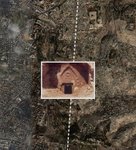
For example, the Talpiot tomb is between Jerusalem and Bethlehem.
Daviau said a more likely site for a Jesus family tomb would be in Galilee, where Jesus lived most of his life.
"That's where the disciples supposedly go after Jesus rises," she said. "They go back to Galilee. They're not going to stay around Jerusalem. It's a dangerous place for them."
Also, Israelites at the time used different burial techniques, said Daviau, who has conducted archeological digs in Holy Land tombs.
Some bodies were buried in wood or lead coffins. Others were placed in tombs and, after decomposing, their bones were placed among those of relatives from several generations.
Ossuaries were heavily used in the Jerusalem-Jericho area, she said, and not widely used in Galilee.
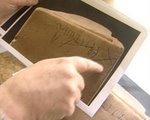
One of the ossuaries in the Talpiot tomb was inscribed in Greek. The filmmakers make a case that it belonged to Mary Magdalene.
But Miller argues that part of the inscription could indicate the name Martha.
Each name found inscribed on the ossuaries was common in Israel at the time of Jesus.
But the filmmakers say the combination of names inscribed on the ossuaries, names associated with Jesus, make the odds at least 600-1 that the tomb belonged to the Holy Family.
There is an added twist.
In 2002, an Israeli antiquities collector revealed an ossuary inscribed with the words "James son of Joseph brother of Jesus."
The makers of Lost Tomb of Jesus say one of the 10 ossuaries from the Talpiot tomb disappeared. So they arranged for a forensic test of the patina, or chemical residue, covering the James ossuary and compared it to one of the ossuaries from the Talpiot tomb. They say both ossuaries came from the same tomb.
If so, they calculate the probability of the Talpiot tomb being Jesus Christ's would be 30,000-1.
But Daviau said the test was too limited. Researchers would need to inspect patina on all the ossuaries found in all Talpiot tombs.
It's possible the James ossuary came from the Talpiot region, but not the tomb in question, she said.
Also, she said, there is evidence the James ossuary was photographed in the 1970s, before the Talpiot tomb was uncovered.
The local scholars said their opinions were only for this slice in time.
As more information comes forth, they agreed, their opinions will change on various parts of the film.
Much more evidence is needed, Daviau said.
"Our opinions now are likely to change, but that doesn't mean they will reverse, necessarily."